
Each day a board certified music therapist packs their instruments, technologies, and other session materials (if you have ever seen one of us…that can be a lot of schlepping), walks out of their front door and loads up their vehicle, or opens their facility or studio doors, they are prepared – not just to provide treatment and care for clients and patients and not just to provide music either. They are prepared to re-present an entire field of board certified music therapy professionals, to advocate for music therapy services, and also to educate every person they encounter who asks: Why do I need to hire a music therapist?
 We understand the question. It is a valid question. This is also a question that most board certified music therapists will tell you they hear every day because most people do not encounter a board certified music therapist every day. More often than not, board certified music therapists are prepared with a range of responses they have for a wide range of environments, opportunities, and audiences. Answering this question is part of what we do. If you ask a board certified music therapist, they will probably tell you they have an explanation for the grocery store, an elevator ride, in a parking lot, walking through a lobby or into any building with instruments or in meetings with other therapy and medical professionals – to answer just that question.
We get it…because we know meeting a board certified music therapist is a bit like seeing a unicorn. We can be hard to find, and even more challenging to find if you are not sure where to look for one of us. The challenge becomes compounded if you do not know what is music therapy. Because of this main factor, for many people, this means traveling to receive treatment by a board certified music therapist. But don’t take our word for it. Let’s talk about the bottom lines, the data and the facts about what is music therapy and what we do.
First: What is music therapy? Music therapy is the HIPAA-compliant, CAM-titled (complimentary alternative medicine) and alternative therapy practice that is the clinical and evidence-based use of music interventions to address and accomplish identified goals by a qualified and credentialed practitioner within a therapeutic relationship. We are classified the same as occupational therapy (OT), physical therapy (PT), and speech language pathology (SLP). This can happen in a private practice, hospitals, schools, community centers, prisons, rehab facilities, mental health facilities, private homes, nursing homes, group homes, homeless shelters, and much more.
Second: What is a board certified music therapist? A board certified music therapist (MT-BC) is a trained and credentialed clinical practitioner who has completed an accredited music therapy program of study and field placements, research, clinical training, an internship, and passed a board certification examination. A board certified music therapist has to have a Bachelor, Master, or PhD in music therapy, have completed 1200 hours of a supervised clinical internship post-studies, and passed the Board Certification examination in Music Therapy. They are also required to complete 100 hours of continuing education and clinical training every 5 years to recertify and retain their credential. And depending on the music therapist, as with other therapy professionals, music therapists have areas of specialization. Without the credential and data collection, what is taking place is not music therapy.
 Within the United States, there are approximately 7,000 board certified music therapists and the numbers of practitioners range from state to state. There are still some states that do not have board certified music therapists in them at all. In the state of Texas, there are just over 415 board certified music therapists working in the field and we make up a little over 8% of the board certified music therapists in the United States. In the state of Texas alone, we 415 treat roughly 41,350 clients and patients each year. This means on average, each practitioner treats approximately 100 clients and/or patients per year; and this does not take into account contracted services for group sessions or clients and patients that travel from out of state – and in some cases out of country – to receive treatment with specializing practitioners. These numbers vary greatly – depending on the circumstances of the state and the needs to be addressed.
In some states, the MT-BC credential and the clinical and educational training that goes into becoming a board certified music therapist is recognized and protected (and we are working hard to get HB 1376 passed in Texas so we can this great state on the list) from those who call themselves “music therapist” but have no clinical training. Many more people and organizations could benefit from music therapy services from a qualified and certified practitioner but are not able to access one due to a lack of state recognition of our clinical training and board certification. Also, with state recognition and licensure, insurance providers and carriers will be less able to deny coverage for a prescribed and viable therapy service.
What are some common questions asked?
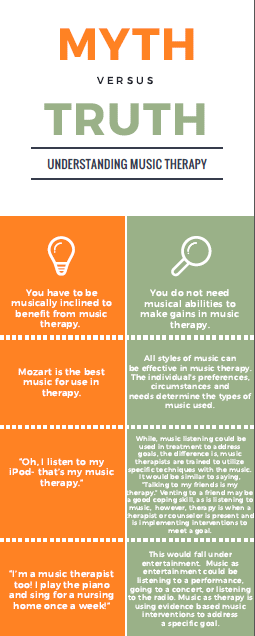
Why can’t a volunteer provide these same services for free? The short answers is: Because a volunteer does not have the educational and clinical training and background necessary to practice therapy. A more involved answer is: There is a difference between the therapeutic use and application of music and the skilled profession of music therapy. Just like you wouldn’t hire a P.E. teacher to provide physical therapy and rehabilitation services, you really do not want an untrained individual – no matter how musically inclined – trying to function as a music therapist. This is not to say that we do not love our music volunteers. Having music volunteers is very helpful for the field of music therapy. We have a shortage of qualified practitioners and an overabundance of need across our great country; but even a music volunteer for music therapy has to go through a measure of training before volunteering can be done. 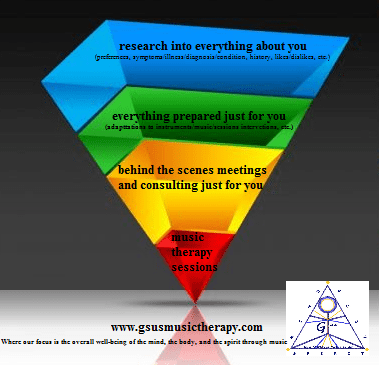
Wait…why do you charge for that? We charge for our services because what we do is a professional therapy service. Just like you expect to pay for services when they are provided by a physical therapist (PT) or a clinical psychologist, you should expect to pay a board certified music therapist when contracting or hiring to receive specialized therapy services. A board certified music therapist follows a process – referral & acceptance, assessment, program planning, implementation, documentation, progress notes, and when the time comes termination – to bring the most effective interventions to address identified and emerging needs. Preparation goes into customizing each intervention for each individual, family, group, or organization…in addition to the learning of preferred music and pairing interventions with instruments or adapting the instruments. Everything a board certified music therapist does is goal-based and established on clinical and medical research, tailored to address specific needs and identified goals, and all of the music that is used is individual- and/or group-preferred.
Just a few examples: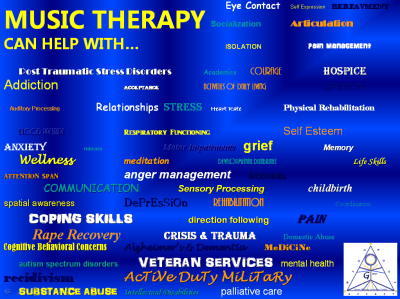
- In the educational setting, Music Therapy is a related service under the Individuals with Disabilities Education Acts (IDEA);
- In mental health, clinical, and healthcare settings, Music Therapy is a HIPAA-compliant, prescribed clinical treatment option and the board certified music therapist works with others on a treatment team to bring the most effect interventions for health (of mind, body, and spirit) and healing;
- In correctional and forensic settings, Music Therapy is a clinical treatment option for those who may find themselves isolated or resistant to talk-based therapies; and
- In business settings, Music Therapy is used to improve employee satisfaction, wellness, and inter-office communication while decreasing rates of employee burnout.
Isn’t it just music? The short answer is: No, it is not just music. The more involved answer is: Therapeutically, neurologically, physiologically, psychotherapeutically, and psychologically, different kinds of music stimulate and elicit different responses within the human body. Using the wrong music can cause more harm and damage than benefit. From the research, 93% of human communication is non-verbal. Music therapy allows a client, patient, and/or group – no matter their environment – to experience and express their full range of emotions about an issue without having to only talk about them.
What does this all mean? Music therapy services help in reducing care costs across a wide range of settings and has the ability to significantly add to the value of services offered through just about any facility or program. Music therapy services help change the atmosphere of any environment. A music therapy program and individual services can add to your program. But don’t take our word for it. Here is an overview of cost-saving analysis and statistics and data on music therapy.
 If you are an employer, manager, or supervisor looking for a new program to improve employee contentment, efficacy, and service output; or you own, manage, or run a program that offers services with individuals with intellectual, developmental, physical, mental or medical disabilities; or you are a caregiver or faith-based institution working to deal with self-care and mitigate the short- and long-term effects of providing services and care for others, or you are a group, organization, or individual looking for a new way to address a recurring, new, or existing issue, music therapy may be just what the doctor ordered. You more than likely ask yourself, “What sets aside my company/brand/institution from the rest? What makes a family choose “us” over “them”? What helps us stand out?”. Hiring a board certified music therapist would allow you to address your needs, as well as gives you an edge in services you offer.
Do you want to make a referral for services? Would you like more information about music therapy? Are you interested in music therapy for yourself, a group, or a loved one? Are you looking for a new approach for a new or recurring situation? Are you a business looking for a new way to address a concern? We are here to help. Give us a call at 512.754.9631, message us here, or at www.gsusmusictherapy.com, or send us an email at gsus.musictherapy@gmail.com.
We wish you the grooviest of days and at least one moment that takes your breath away and makes your heart smile!
The Gsus Music Therapy Treatment Team
 We will have all have trials and troubles that will bring us people, problems, pain, and pressures. Take heart, you are not alone. There is one universal truth we all have to face if we are to keep living. And it is our sincere hope and prayer that you will always choose life. The universal truth is that life is something we have to feel, something we all need to live. There is no escaping it. Life will keep coming – whether we want it to or not, whether we feel prepared for it or not, whether we feel strong enough for what it will require of us or not. Take a moment to check-in with yourself. Be honest with you.
 If you are an adult who did not receive, for whatever reason, what you needed from your mother, your father, your family, your environment, your upbringing, your interpersonal and/or professional relationships, your faith, your job, or anything else you needed to grow up and into a confident, secure, self-assured individual, who believes in his/her worthiness as a human being, this is for you. This is not about bashing any of the people, places, or things mentioned because the goal is healing, wellness, and overcoming – even if the people, problems, pains, and pressures keep coming or do not change. We are interested in helping you find the bottom line, so you can let go to go on and have a more fulfilled life. We want to help you overcome, to succeed as you define success for your life.
 Everything that has happened to you, every negative thing that was said to you, every label that has been heaped on you – mind, body, and spirit – every thing that life did not give you, every thing you thought would happen, but didn’t, you need to know you are important, you are worthy, you are loved, and you are needed. There is more in this life for you. The bottom line is this: you are still here, Beloved. No matter what this life has thrown at you, you are still here. No matter what this life did or did not give you so far, you are still here. As long as there is life in your body, as long as you have a heartbeat, as long as you are breathing – and definitely if you can read this – you are yet and still here and there is more in this life for you.
  A mental health need is not a figment of the imagination and it cannot always be “walked off”. Any mental health need is very real. You need to know, there is more in this life for you – no matter your circumstance or situation. We are here to help you learn new coping strategies to deal with the people, problems, pains, and pressures of life. A life filled with conflicted thinking, strange thoughts, pervasive thoughts, or redundant thoughts does not have to be all there is for you. We are not here to judge. We are here to help. You are worthy of a fulfilled life. You are worthy of your healing. You are valued. You are needed. You are priceless.
 Gsus Music Therapy Services & Center, LLC